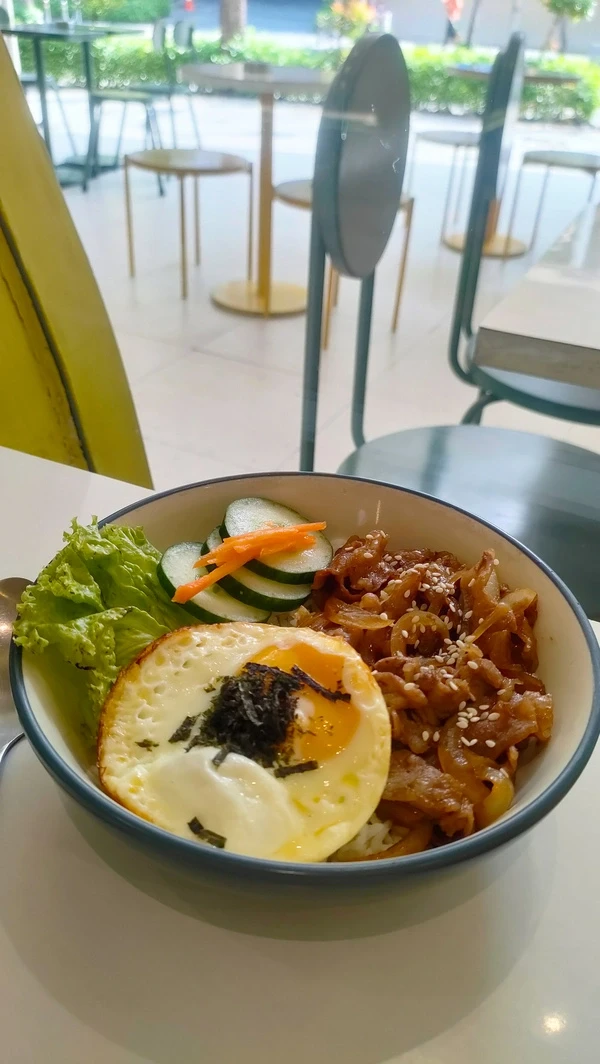
When your cafes’ online pages fail to drive diners, even after attracting attention, the likely issue is that you treat on-page SEO as a hygiene checklist. On-page SEO is important because it controls how search engines interpret relevance, how the engine users perceive trust, and how clicks convert into revenue. This can be improved by addressing several factors, including content quality, technical optimisation, and mobile-friendliness.
Reducing on-page SEO to instruction of “just fix the meta tags” will only make you fail in linking the pages to revenue in your reporting. Your cafe’s owners will ask why SEO isn’t working in their business, while teams see competitors get more organic traffic by using the same keyword. This happens because on-page SEO was never designed to guide buying decisions.
On-Page SEO as a Revenue Control Layer
If you’re short on time, you just need an audit checklist for on-page SEO. But mind reviewing your reporting structure, especially its logic for prioritising actions.
On-page SEO controls three variables that leadership actually cares about, as shown in the infographic below.
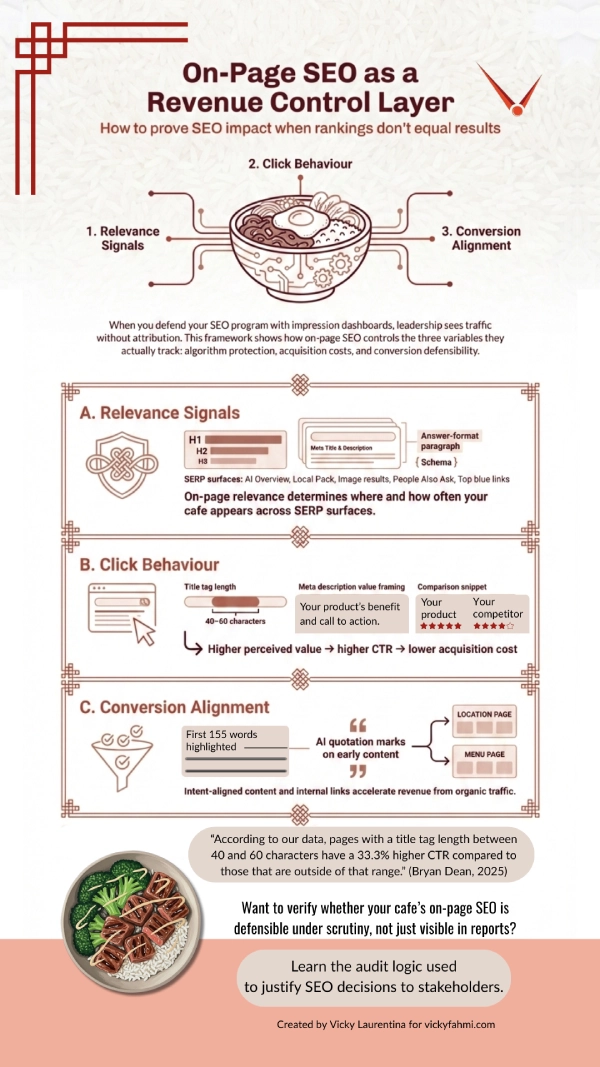
As shown in the infographic above, relevance signals are elements on your web pages that determine whether your cafe can withstand search engine algorithm changes or quietly lose qualified traffic in a stable ranking. These elements include heading hierarchy, meta tags, answer-formatting paragraphs, and schema markup.
Optimising these elements can help your cafe stand out in key positions on search engine result pages (SERP), capturing visitors’ primary attention when searching for culinary content. Each of these placements affects click distribution differently. Treating these elements as “tools for surfacing the conversions on SERP” can help you reduce acquisition costs and increase CTR.
Those spots are AI Overview, Local Pack, Image, People Also Ask, and the three blue links at the top of the first page. The more often your content is seen, the more likely you are to get clicks (or, in other words, get higher CTR).
What about click behaviour? Well, each cafe competes on the SERP for specific keywords. This competition can be challenging, which sometimes leads you to boost your content’s visibility through ads. Aren’t you tired of paying for monthly ads just to get more customers?
But optimising the two signals above (title and meta description) can help your content be seen as having greater value than your competitors’. This hinted value will encourage people to click your link, ultimately driving more organic clicks without the need for ads, which certainly reduces your cost per acquisition.
Meanwhile, good on-page SEO also optimises the earliest text in the content to align with the user intent of the people who need to convert. This is achieved by several actions, such as optimising the first 155 words to match people with buying intent, so your cafe can generate revenue faster from organic traffic. These earliest words are content scanned by the AI, and making the AI quote them helps make your cafe more visible and attract foot traffic.
Another action that aligns content with buyers is arranging internal links to guide visitors toward conversion paths. Content that discusses a type of meal should encourage readers to seek the meal, which we should achieve by using an internal link that directs them to information about a place where they can get it.
Executing on-page SEO to improve your cafe’s conversion rate will be challenging, as requesting approval will be difficult.
The difference between approved executions and those that got cut is whether the efforts can be audited, prioritised, and defended with numbers.
Vicky Laurentina, 2026
Do you start to understand what to execute next?
Execution, Validation, and Proof
Defensibility in on-page SEO comes when it’s auditable. Leadership rarely accepts the “best practices”, which sounds abstract. However, they trust documented decisions supported by before-and-after evidence, which is why the following section explains how to check your work and communicate it clearly.
This section will show you how to audit pages, prove impact, and defend your decisions.
Checking On-Page SEO in Practice
Below is how to check on-page SEO using a systematic approach that yields reportable findings.
This probably looks long because leadership scrutiny requires completeness, not because the execution is complex.
Step 1. Verify the Match of Search Intent
I use Google Search Console to identify a website’s top 20 ranking pages. For each page, I compare the H1 and title tag to the actual search queries that have triggered impressions.
You can seek misalignment to identify any structural drift. For example:
- A page targeting the query “bulgogi recipe”, but ranks for the query “bulgogi restaurant delivery”.
- A page ranked in first or third positions, but only for image search, not web search, due to a format mismatch.
Success in food search increasingly depends on image visibility, and image optimisation differs from text optimisation. Text blocks are easily extracted by AI when supported by explicit headings and schema, while images depend heavily on brand authority to earn citations. Without brand authority, image search tends to generate impressions without clicks, even when visuals are well-optimised.
Have you ever reported on the rise in your image impressions without a traffic lift?
Step 2. Audit Title Tag and Meta Description Performance
Auditing those signals involves exporting GSC data for pages with >1,000 impressions. I calculate CTR by position.
A case study on a SaaS platform’s website found that pages ranking #4 achieved only 8% CTR, while those ranking #3 achieved 11%. So I decided that pages ranking #3 with a CTR below 8% likely have weak metadata. This weak metadata can be improved by rewriting the title and meta description and by providing hints about the query’s answer.
Step 3. Check Schema Markup Implementation
Google’s Rich Results Test should be run on the five highest-traffic pages to identify missing schema. Missing schema means our content is invisible to AI and ineligible for rich snippets, which will prevent us from getting clicks.
Product schema on a cafe website can make your meal appear more frequently in the search results and materially lift CTR. Schema markup helps search engines interpret and prioritise key information by explicitly defining the meaning of your content.
Step 4. Validate Heading Structure Logic
By opening each page’s source, we can review the H1, H2, and H3 hierarchy. The H1 should address our target query, and each H2 should address a distinct sub-question from the target query. While H3s should provide supporting detail.
You’ve probably set your article page with the title “bulgogi rice in XXX Cafe”. But setting the H2 with “Our Speciality” should be flagged as generic, because generic headings don’t get quoted by AI. Tagging it with a more specific one, like “How Signature Marinade Makes Bulgogi Rice Perfect”, helps your product to be recognised by AI.
Heading tags are critical because they highlight the page’s theme, with H1 carrying the most weight and H3 the least. Keep your structure to H1 through H3 for optimal impact.
I’ll tell you why this structure matters in another content, just stay in touch with me.
Step 5. Analyse Internal Link Architecture
Map the internal link flow using a tool, e.g Screaming Frog or similar tools. Pages critical for conversion should receive the most internal links from high-authority pages. This is why strategic internal linking is fundamental to understanding how revenue flows through your site architecture.
“URLs with 0-4 internal links only saw two clicks on average from Google Search, while URLs with 40-44 internal links saw four times that many.” (Shephard, 2026).
A leak in structural revenue can occur if, for example, your “About Our Cafe” page has eight internal links, but your “Bulgogi Rice” page has only three. Your product page is the revenue bringer, not the “About” page. Or isn’t it?
Step 6. Test Mobile Rendering and Core Web Vitals
Run PageSpeed Insights on key pages to identify on-page elements that affect your visibility in SERPs and AI. Some elements can directly impact Core Web Vitals, which in turn affect other machines that read your page and hinder their ability to understand it. These elements are usually large hero images of your meal, uncompressed files of your interior video, or a render-blocking script for a “join our WhatsApp channel” pop-up.
Pages that already meet Core Web Vitals thresholds and load ordering-related content under three seconds should be temporarily deprioritised, allowing teams to resolve higher-impact structural problems first.
Even if your goal is not to improve your visibility, misconfigured elements can disrupt your audience’s mobile experience by slowing page load times. Your audience can’t read your page in full because the pages take too long to load, which disrupts their will to buy your meal.
Do you want to know the threshold time for patience when waiting for a webpage to load? Three seconds.
Step 7. Optimise Image Metadata Systematically
Revenue leakage frequently occurs at the image level. Once, I left the images on the website with only the title and filename, which had been optimised for target queries. This action yields only a small improvement in making the images understandable to AI, limiting the images from being discovered.
Expanding optimisation to additional image metadata fields can make the page more frequently seen in search engines and AI. Although this step rarely moves the ranking on its own, it prevents AI and image systems from misclassifying otherwise strong pages.
An experienced agency owner once taught me to optimise images in the tag, description, comment, and copyright fields. This does matter to enable the image scanned by AI.
Once you’ve completed those seven checks, the next challenge is making your findings can be actioned. Don’t miss the execution next.
Turning Findings Into Clear Reports
Making on-page SEO auditable to leadership requires translation, not just data. When I created an SEO report, I avoided the “walls of metrics” problem by using a structure that included an executive summary, a key metrics section, challenge findings, and prioritised recommendations.
| Report Section | Key Elements | Example |
| Executive summary | Business problem + on-page cause + expected impact | “Traffic increased 10.2%, but leads -8.1%. Cause: Pages rank for queries about cultural habit bulgogi-rice related, but lack conversion paths. Fix: Restructure 5 pages for 10-15% qualified traffic boost.” |
| Key metrics | CTR by position, schema presence, pages ranking, clicks | “CTR 2.1% = 1% below benchmark = 1,200 lost clicks valued at $42 each.” |
| Challenge findings | Intent misalignment, structural gaps, technical barriers | “‘Bulgogi delivery’ ranks #2, but lacks local business schema = about 100 monthly clicks lost to competitors with rich snippets showing hours or location.” |
| Prioritised recommendations | P1 (do earlier), P2 (do next month, or if P1 has been completed), P3 (do when P2 has been stable). | “P1: Fix schema on top 5 pages” |
In the executive summary, the business problem and its on-page cause are stated, then end with the recommended fix with expected impact.
The section of key metrics should include metrics that leadership understand, but relate it with on-SEO page elements that we’ve optimised. Additional metrics can be included at your discretion, but providing every metric should be accompanied by a sentence explaining why it matters to revenue.
It would be more effective to also show the audience’s path from the most-clicked page to the other page via the internal links we’ve built.
Meanwhile, each challenge findings should be grouped into:
- Intent misalignment, where pages have ranked into wrong queries.
- Structural gaps, such as missing schema and weak headings.
- Technical barriers, such as slow load and mobile issues.
Every identified issue should be supported by visual evidence and a business impact that you can measure.
Recommendations should be prioritised based on revenue impact and ease of implementation. Efforts with high impact and low effort should go first.
Teams usually fail because they present ten recommendations without a priority order, so nothing gets done. I usually prioritise recommendations in three tiers: P1, P2, and P3.
Format like this usually works because it’s designed to defend the request to the board of leadership, who typically don’t understand the SEO problem. This framework can easily secure budget approval within companies by helping marketing teams articulate the return on investment. Most teams fail to demonstrate causation, even though it’s critical.
Defensible reporting like this focuses on measurable problems that can be fixed. If any findings cannot be tied to changes in clicks or revenue, they should be excluded.
From Execution to Accountable Support
Execution only matters if it can be sustained, defended, and adjusted as search behaviour changes. After identifying which on-page SEO elements require intervention, the next challenge is deciding how to apply those changes within our CMS. The goal should be a structure that remains intelligible to machines, teams, and leadership, as conditions evolve.
Systematic On-Page SEO Execution Inside the CMS
The principle of on-page execution remains consistent: clarity should beat creativity, structure should beat keywords, and the decisions that can be audited should beat the guesswork.
I’ll explain how to do on-page SEO in WordPress, the most widely used platform for marketers worldwide. This CMS is only an example, from which you can imitate the principle in other CMSs like Shopify or Magento.
How to do on-page SEO
- Avoiding website themes that create duplicate H1S.
Because a double H1 will hinder the crawler’s ability to understand the website’s page structure. If I found the theme still created double H1, I’d replace the theme.
- Structuring the headings hierarchy on each page.
Ensure the page has a heading hierarchy which is neatly structured, from H1 to H2 to H3, and avoid skipping levels. SEO plugins like Yoast can help scan the heading hierarchy across all pages faster, saving me time, and they also work with other CMS platforms such as Shopify and Magento. Its heading structure must be read in the page source.
- Rewriting the title tag and metadescription to suit the search intent.
All transactional pages should be titled with the keyword that the buyer intends to search for. Its metadescription should also be rewritten to be more relevant to people looking to buy a meal. Pages that are not intended to drive transactions will require titles and meta descriptions aligned with consideration or awareness-stage intent, rather than purchase language.
- Set the breadcrumb in the article and product pages.
Breadcrumbs help search engines determine which page belongs to which category. On a cafe website, a breadcrumb page helps search engines recognise the menu as a specific food category.
A dry-serve menu offering, such as your bulgogi deokbap, may follow a breadcrumb path like “Home > Dry-Serve > Bulgogi Deokbap”. This will differ from the other menu you probably offer for guests who want a soup. Example: “Home > Soup > Ttukbaegi Bulgogi”.
Set your breadcrumbs in the HTML header or in Yoast. - Set the Schema.
Schema markup should be applied consistently across all pages. Setting the schema markup as Article in your article will help search engines authorise it as content from a cafe. This will also highlight your cafe and strengthen your authority in AI.
Configure the blocks of FAQ and How-To for relevant content types. These types of blocks are usually needed for pages intended to serve audiences who want to order delivery or make a reservation.
Schema markup for the Restaurant Page and Menu Page should be implemented on your pages to signal that your brand offers a cafe and meals. - Use the internal linking block strategically.
High-authority pages should link to conversion paths. Consideration-stage pages should link to transactional-stage pages, not just related posts.
Are you beginning to estimate what additional budget do you need to execute these steps?
Maintaining Structural Advantage as Search Behaviour Shifts
Search behaviour changes faster than most content calendars can keep up with. Monitoring how intent evolves and adjusting the page hierarchy will give you a structural advantage before your performance erodes.
Quarterly, I review schema implementation against Google’s evolving guidelines, as Google regularly adds new types. For example, according to a website of a schema markup service, in Q3 2023, Google rolled out structured data documentation for Profile Page, Course Info, and Discussion Forum, which had not previously existed. Early adoption gives a competitive advantage.
Restructuring the content hierarchy is likely needed, and likely annually, as search behaviour can change.
Ten years ago, the query “bulgogi rice” was typed by people who just wanted to know what meal it was. But today, at my location, the same query was typed by people looking for where to buy it. This kind of change prompts me to rewrite the content, at least the first 155 words, to align with the latest user intent.
Improving on-page SEO helped my clients be seen more frequently in search results, especially when the effort pushes their content to the top 3 in SERPs.
“Moving up from #2 to the #1 spot will result in 74.5% more clicks.” (Dean, 2025)
Certainly, this will be much easier for you if AI summaries don’t dominate.
Holistic improvement in on-page SEO requires holistic integration of content quality, technical optimisation, and user experience. This means our improvement roadmap should address the competitive necessities below:
- Content freshness through regular updates,
- Page load speed optimisation,
- Elimination of broken links and technical errors
- Clear site navigation architecture.
A dedicated on-page SEO service becomes relevant once you need to own the structure.
It is a service which includes technical audit (identifying structural and code-level issues), content optimisation (aligning existing pages with search intent), schema implementation (enabling rich results and AI citations), internal linking strategy (distributing authority toward conversion paths), and ongoing monitoring (identifying performance changes before they become crises).
However, this service excludes content creation and backlink building (both are off-page SEO activities).
When I work with clients, I don’t just optimise pages. I document the decision framework. My goal is to make the team understand why the schema goes here, why this H2 structure matters, and why we’re deprioritising that keyword.
Certainly, I can help people who have been burned by arbitrary SEO tasks and now need to optimise for something they can explain. Like you.
I’ve built on-page strategies for hospitality businesses where the goal wasn’t more visitors, but it was better visitors. Your cafe should target people searching “bulgogi rice near me delivery tonight” rather than “what is bulgogi.” That’s a structural SEO decision, not a content decision.
Strategic on-page SEO is about making decisions that can survive scrutiny, that you can prioritise, defend, and explain when performance is questioned. If you’re responsible for turning SEO work into outcomes that leadership actually trusts, the next step should be to judge more clearly, prioritise more strongly, and get accountable support behind the decisions you make.
Find out how I work with teams who need on-page SEO to be explainable, defensible, and tied to real business impact. If you’re comparing agencies or paths of internal execution, this is how I stress-test on-page decisions before recommending action.
No execution obligation. Evaluation only.
This page was published firstly at June 4th of 2022, but updated at February 2nd of 2026 to give you latest insights.

I am a content strategist who loves blogging about planning and optimising content for marketing insights. See my profile page to find out more about me. Follow me on LinkedIn and Instagram.
Aku suka bingung. Semisal cek queri di GSC itu apakah kita menang perlu buat artikel baru lagi atau bisa nyelip-nyelipin aja di artikel lama. Well. Banyak pertimbangan. Jadi bikin nggak gerak-gerak. Anyway, thank you insight nya. Aku jadi bisa memikirkan jalan yang ingin kucoba untuk blogku.
Tiap blogger punya pertimbangan sendiri-sendiri ya, jadi mungkin pertimbanganku dengan pertimbangan Yuni itu berbeda.
Pada dasarnya, nggak semua queries itu cocok untuk diselipin ke dalem suatu artikel, karena ada perbedaan konteks antara beberapa queries dengan konteks artikelnya. Dan perbedaan konteks ini terjadi karena “gap” antara tingkat pengetahuan pengunjung dengan pengetahuan bloggernya.
Kalau konteks query-nya udah beda gini, maka query nggak perlu dimasukin ke artikel, dan membuat artikel baru tentu adalah tindakan yang lebih bijaksana. Tapi kalau konteks query-nya masih sama dengan konteks artikelnya, maka tinggal dimasukin aja ke dalem artikelnya.