
Plenty of businesses, including restaurants, routinely improve their websites by refreshing their pages. However, they still face less visibility than their competitors in the AI landscape, leading them to feel that website improvements are a waste of time. Conversely, my experience shows that webpage edits that can improve visibility require aligning search intent earlier, a step often overlooked by many marketing teams.
To perform on-page SEO, first determine the topic the page will cover so that every page element is geared toward supporting the same search intent for that topic. From there, optimize in the following order:
- Define the topic
- Choose internal links
- Revise the topic on the page
- Fix the slug, if necessary
- Repair the title
- Strengthen H1
- Adjust H2 and H3 headings
- Rewrite the introductory paragraph
- Enhance the images
- Validate each element so that both humans and search engines can understand the content’s topic.
What’s frequently misunderstood is that defining the topic is not the same as deciding on the keyword, and I’ll explain why in this article.
Every Priority Begins Somewhere
As an SEO specialist, I approach optimization differently than most agencies do, because each decision heavily depends on the previous ones. For example, a title won’t appeal to the desired audience unless we determine a topic that truly appeals to them. Similarly, a slug is also determined by its topic, as you can’t expect your restaurant to be cited by AI if your slug still reads /xyz, can you?
Topic Selection Defines Any Later Decision
Since Semrush has taught many people about query types based on search intent, you might also have considered classifying queries into four conventional types: informational, navigational, commercial, and transactional. Generally, this classification begins with asking whether the query’s purpose is truly to generate revenue for the business on the website.
But I tend to ask a more critical question. I first investigate whether website visitors who type in their prompt with that query can actually be served by the business behind the website.
For example, if a restaurant has a website, and its website appears as an AI-generated answer to the “dolsot bibimbap recipe for winter dish” query, I don’t think this visibility will benefit its revenue. Because people typing in a query like this only want instructions on how to cook themselves, not to reserve a table at the restaurant.
To do on-page optimization, I prefer determining the business’s goal early. Are they selling a service, already looking to increase the number of loyal customers, or just trying to increase their popularity? After identifying the goal, I then determine which content to optimize.
Each topic selection creates derivative decisions, such as:
- which pages to optimize first,
- which internal links to direct to these pages,
- what appropriate alt text for images to align with the topic,
- and so on.
And this is what differentiates my optimization process from that of other marketers: Perhaps their routine involves busying themselves with more viral titles and prettier photos, even though their business goals don’t align with their titles and images. As a result, when marketers try to type prompts that align with their business revenue goals (for example, “bibimbap for lunch breaks around London CBD“), their business name doesn’t appear.
Business Intent Changes Optimisation Priorities
Restaurants often create a dedicated page for their menu, hoping that after reading it, people will book a table.
For example, a Korean restaurant A might publish a page listing their specialties, including beef, chicken, and fish bibimbap. Then a second Korean spot B publishes a menu, too. But Spot B only features fish bibimbap in a variety of spices, as that’s the only dish they offer.
Then, someone comes along who wants fish bibimbap. When they see both Korean eatery menu pages, they’ll likely choose Spot B, believing it specializes in hoedeopbap, not all types of rice bowls.
It’s fine if your K-spot offers a wide variety of rice bowls and you want to market them all on a page. However, it becomes a problem if, of all the bowls you offer, the hardest dish to sell is the type with fish topping, and your logistics will be disrupted by an unsold fish menu.
This is where optimizing a focused page to market your fish rice bowl becomes crucial. It’s a mistake to spend time updating your entire website when:
- not all pages need refinement,
- while your kitchen logistics team complains about poor-selling menu items,
- and you haven’t spent enough time optimizing this particular menu page.
So, optimization doesn’t mean rewriting the whole website. But it’s important to first identify the problems your business is facing and which content, if optimized, would most quickly help solve those problems.
Next Decide Page Relationships
Once I’ve defined a restaurant page’s topic, I decide how it supports the website’s internal systems through internal link planning. These links are crucial because they determine how people and search systems navigate their business, not just to fulfill a checklist you might see on LinkedIn.
A page must receive links from other pages covering related topics to help search systems determine its content’s relevance to website visitors. Furthermore, the same page must also direct visitors to other pages so that visitors can complete their business objectives. Without these two link types, even the best-written page will struggle to be seen in search systems.
For example, I’ll optimize a page about beef bibimbap on a restaurant website by providing incoming internal links from a page containing a roundup of the eatery’s dishes. On the same bibimbap page, I’ll also include outgoing internal links to a page about the restaurant’s location, or even to the reservation page.
I summarize the optimization process in the following infographic.
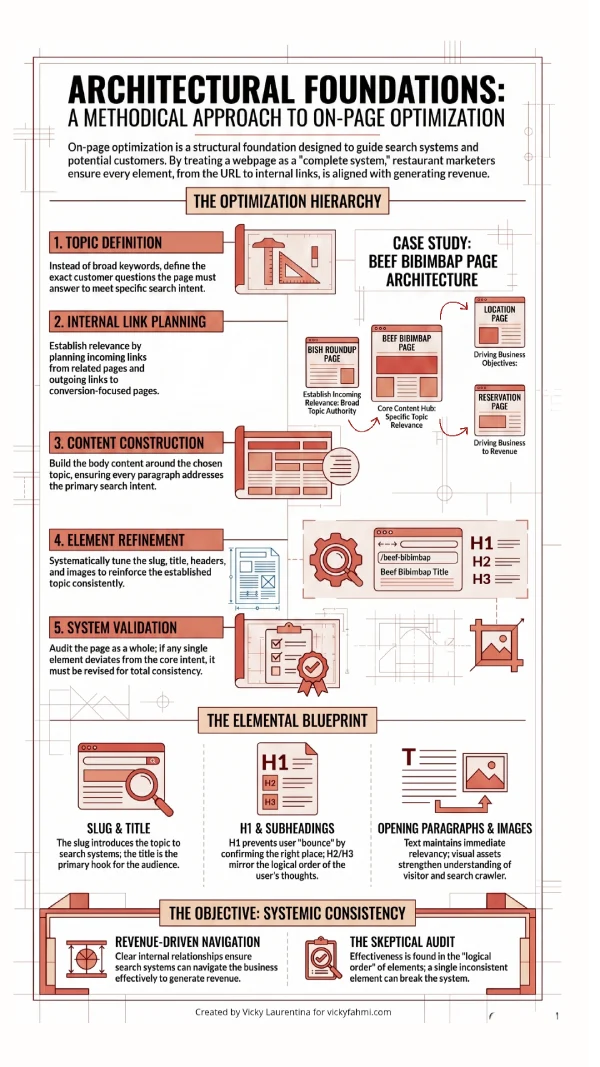
If the relationship between one page and another is clearly visible through these links, other elements will be much easier to optimize. Because all pages move in the same direction: generating revenue for the business behind the website.
So, on-page optimization is a lot of work, but the priorities above will help you.
Finally Judge Overall Page Quality
In on-page SEO, I see a more important priority than just quantitatively examining the page elements. It’s about deciding how influential optimizing one page is compared to others for the brand’s revenue behind their website.
Practitioners Notice Different Quality Signals
Because the process is called on-page optimization, many people still assume that improvements are performed inside the page itself. It’s no surprise, then, that the established metric for measuring this process’s success is limited to increased traffic per page. However..
I’ve seen that page improvements have successfully moved the needle toward greater revenue when the process is implemented on a website-wide basis rather than improving one page or two.
Vicky Laurentina, 2026
When I performed on-page optimization by improving pages one by one based on their respective keywords, the results were inconsistent. Some pages saw improved rankings, while others saw a decline.
However, when I implemented a different strategy, namely first determining the search intent of the target audience, the results were different. AI visibility improved, and there were more audiences wanting to interact with the brand behind the website.
Determining the website’s search intent enables me to map which topics have (not) been served by the website. For topics that have already been served, I can check whether the content is optimal for attracting leads or whether it still needs further refinement. Meanwhile, for topics that haven’t been served, I can choose between including them on the agenda to create new pages and delegating them to pages with duplicate content.
When all topics are well-mapped, search systems more easily understand the completeness of the website’s content, thereby strengthening its authority and enabling the engines to recommend it in AI-generated answers.
Anyone can easily see whether a page has a title containing a keyword. They also can easily whether its images contain alt text that, hopefully, also contains keywords.
But mapping content to see whether it meets the needs of people searching or prompting is a skill that requires considerable practice across various website niches. Seeing the ability of each internal link to strengthen the website’s topic and identifying duplicate content, which often occurs unintentionally, also requires years of content strategy expertise. Things like this are often invisible if the website is only optimized by reviewing pages one by one.
Before Optimising Another Page
Ineffective tactics are still made when optimizing websites today, and I summarize them in the following table.
| Common Mistake | Why It Wastes Your Time and Money |
| Chasing keywords which not solve for the customer | You end up rewriting titles and descriptions to fit a phrase, without fixing the real reason customers aren’t booking. |
| Adding unrelated links from other pages | Links from unrelated pages confuse search systems about what your page is really about, so your best pages don’t get properly noticed. |
| Making pages longer just to match competitors | Length doesn’t build trust, and it costs you writing hours that don’t move bookings. |
| Adding unnecessary technical extras (like FAQ code) to pages | This adds setup cost without addressing why the page isn’t converting in the first place. |
One mistake above happens because many marketers still believe a page needs to rank for a specific keyword. But most mistakes happen because marketers treat optimization as a website-related checklist without understanding why particular elements need to be optimized.
All of these mistakes stem from a misunderstanding of the website’s function for a brand, where the website is treated as a mere accessory.
I always ensure that every website is useful to its intended audience, and website effectiveness occurs only when each page supports the audience’s needs at every stage of their journey. This inter-page support is difficult to achieve when optimization is aimed solely at the page’s benefit, rather than the website’s ultimate goal. Websites that routinely perform optimization without viewing each page as part of a topic system rarely improve their visibility.
To ensure optimization doesn’t overextend your efforts, which pages should be prioritized to move the needle faster toward revenue? Answering this question requires an SEO specialist who can identify the structural relationships between pages within a topic. By identifying the correct relationships on your website, you can prioritize pages for optimization and make your brand more visible in search systems.
Request a diagnostic briefing to identify the content relationships on your website, on my profile page today.
This page was originally published on June 4, 2022, and updated on July 7, 2026, to reflect the latest information and insights.

I am an SEO specialist with experience as a content strategist. I blog about planning and optimising content for marketing insights. See my profile page to find out more about me. Follow me on LinkedIn and Instagram.
Aku suka bingung. Semisal cek queri di GSC itu apakah kita menang perlu buat artikel baru lagi atau bisa nyelip-nyelipin aja di artikel lama. Well. Banyak pertimbangan. Jadi bikin nggak gerak-gerak. Anyway, thank you insight nya. Aku jadi bisa memikirkan jalan yang ingin kucoba untuk blogku.
Tiap blogger punya pertimbangan sendiri-sendiri ya, jadi mungkin pertimbanganku dengan pertimbangan Yuni itu berbeda.
Pada dasarnya, nggak semua queries itu cocok untuk diselipin ke dalem suatu artikel, karena ada perbedaan konteks antara beberapa queries dengan konteks artikelnya. Dan perbedaan konteks ini terjadi karena “gap” antara tingkat pengetahuan pengunjung dengan pengetahuan bloggernya.
Kalau konteks query-nya udah beda gini, maka query nggak perlu dimasukin ke artikel, dan membuat artikel baru tentu adalah tindakan yang lebih bijaksana. Tapi kalau konteks query-nya masih sama dengan konteks artikelnya, maka tinggal dimasukin aja ke dalem artikelnya.