
People can work remotely from cafés because these spaces provide high-speed Wi-Fi, comfortable seating, and a social environment that supports both focus and engagement.
You can see today how laptop users are already filling your tables, staying longer than typical dine-in guests and returning more often than your reports can confirm. Though the behaviour is visible, unfortunately, its revenue impact is not yet apparent.
Most café operators do not lack traffic; they just lack a way to interpret it. Remote workers move in and out, yet their visits rarely translate into structured repeat patterns or measurable outcomes. So, without a clear framework, daily foot traffic will remain disconnected from the value it could build.
Remote Work Behaviour and Cafe Revenue
Remote workers don’t choose cafes randomly. They’ll stay if the environment supports focus, and the ambience also reduces isolation. This must’ve been matching what you’re seeing in-store.
Research on hybrid coworking shows that as cafes function as community hubs, people can also work individually while maintaining a sense of social connection. This is implied in the research below,
The hybrid coworking spaces then creates a unified community hub that help reduce loneliness and build social connections among remote workers. (Syamsiyah, 2025)
When this experience is consistent for customers, they’ll return. You can turn repeating visits into something that you can predict as a marketer, and this predictable behaviour will begin your revenue.
Below is the framework to show how the behaviour of people who work from cafe become a revenue:
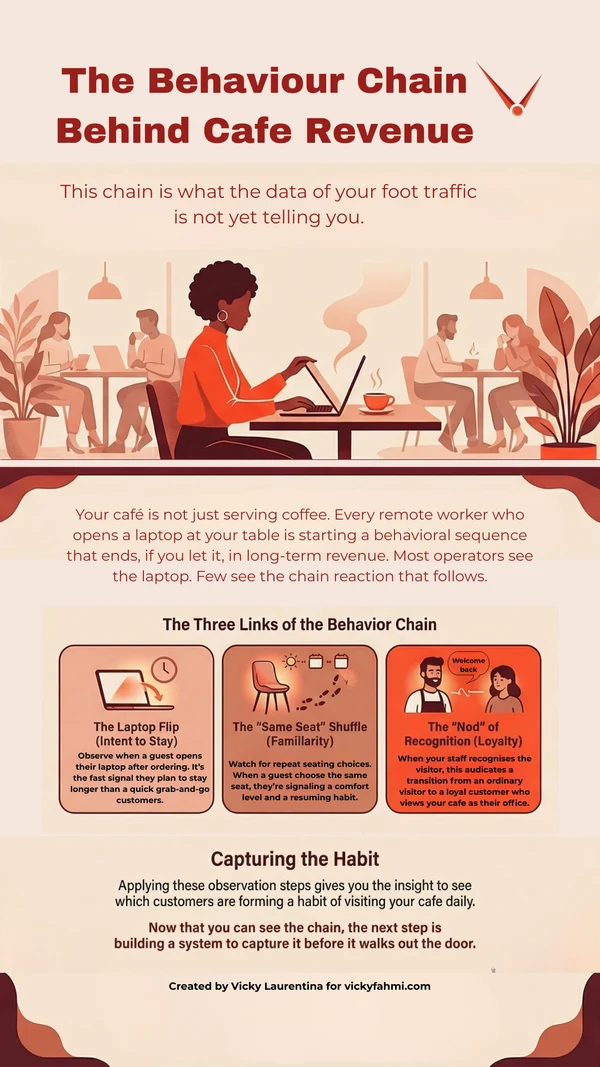
Familiarity will drive repeat visits, and over time, it will strengthen into a preference.
Most cafes already have this behaviour, and probably yours, too. Your task is to capture these patterns, because failing to do so will make your repeat visits invisible rather than a measurable revenue stream.
Turn the Coworking Behaviour into Signals
Every 2 hours, it’s easy to find one of your guests opening her laptop at your table after ordering another cup of coffee, a sign that she’ll stay longer. But without a structured approach, this kind of behaviour will remain anecdotal rather than something you can take action on. So what does a ‘structured approach’ actually look like in practice?
Read the steps below about turning a certain visitor’s behaviour into a signal of strategic action:
| Step | Behaviour to Observe | Signal It Indicates |
| 1 | Patterns of laptop usage, including reordering beverages to extend the session | Customer intends to stay longer, increasing the potential of average spend |
| 2 | Repeat seating choices across multiple visits, such as returning to the same table/corner | Customer is building familiarity with space, a precursor to habitual visits |
| 3 | Moments of staff recognition, such as a barista greeting a returning customer by name | Customer has crossed from occasional visitor into early territory of loyalty |
Applying these memorising steps will give you insight to use. Over time, these signals reveal which customers are forming a habit of visiting your cafe.
By the way, you need to familiar yourself with some terms that market your business for people who want to work from a cafe. A cafe is different from a coworking space, which is designed for people who want to work in a coworking environment.
Coworking means working independently within a shared social environment. These people spend time in the same room, but each works for a different business or, specifically, for freelancers on different projects.
Some businesses can register formally as coworking spaces. But some businesses still declare themselves cafes where customers are allowed to cowork, as long as they make a minimum payment to order beverages. These are called informal or hybrid coworking spaces, or cafes where people can enjoy beverages and do their work.
Understanding those terms will help you clarify who your repeat customers actually are and what they expect when they visit your place. There’ll be a possibility when customers will keep repeating their visits and also bring their companions to enhance their coworking.
The same study above has also shown that cafes now increasingly function as community hubs, and remote workers treat physical cafes as part of their coworking activities. Capturing the behaviour is the point at which you begin to generate revenue.
What Makes a Coworking Cafe Work
Your coworking cafe succeeds when you have designed the infrastructure, atmosphere, and social environment to blend in harmony. Each factor contributes to the customer experience, and any weak factor reduces their productivity and deters their likelihood of returning. I’ll tell you which one matters more for retention soon.
Characteristics of an Effective Space
The following factors make a coworking cafe an efficient workspace.
The coworking cafe’s infrastructure must be reliable to keep the customer focus. The infrastructure includes a strong Wi-Fi connection, power outlets accessible to all customers, and a beverage service that meets customers’ basic needs.
Atmosphere matters just as much as background noise, which should be moderate. A little noise is still needed to provide the energy of coworking, but it should be kept to a minimum to avoid creating a distraction. The room should not feel overwhelming nor isolating.
Food and beverages should be curated to be simple and predictable. Simple food and coffee are needed to maintain focus during long work sessions, without drawing attention away from customers’ work tasks.
Finally, social recognition is critical. Staff who acknowledge returning customers can transform their comfort into familiarity, which encourages repeat business and loyalty.
All of these elements simultaneously create a balanced environment of long-session work, encourage engagement, and build the customers’ habit of using the cafe. Have you decided which element you should fix first if one of your stores underperforms?
Failures That Break the Retention Chain
Numerous cafe operators fail to attract remote workers back to their cafes. It’s usually because these operators design their cafes to focus in estetics rather than support productivity.
A beautiful interior can attract first-time visitors. But uncomfortable seating during long work sessions, unstable Wi-Fi, or even limited power outlets will keep coworkers from becoming regular visitors.
Usability earns second visit (and third, and after). But pretty ambience only earns you a snapshoot, which probably only goes viral for a week.
Vicky Laurentina, 2025
Ignoring recognition is another failure of a coworking cafe. It’s a shame, because it doesn’t actually cost too much.
When your staff treats each visit like a first-time visit, you lose the opportunity from being preference by your customers who need to feel special. Recognising signs of belonging can transform your visitor’s occasional visits into something you can predict.
And if you don’t track any laptop users, you don’t act on, or even record, the behavioural signal. This is the moment when your retention begins to leak. Yes, that’s blunt.. but accurate.
Your cafes likely have repeated visitors who are busy with their laptops for hours. Creating a system to track these returners can provide long-term value that helps compound your revenue. Try the next step in the article below: craft a framework that connects the customer’s behaviour to the business outcome you haven’t measured.
This article was published on October 12th, 2023, but was updated on March 28th, 2026, to give you more insight.

I am an SEO specialist with experience as a content strategist. I blog about planning and optimising content for marketing insights. See my profile page to find out more about me. Follow me on LinkedIn and Instagram.
Aku sendiri belum pernah coba kerja di co-working space. Tp karena saya kerja dr rumah, boleh sih jd pilihan kalau suntuk di rumah. Belum tahu juga di kota saya ada apa ngga ya co-working space nyaman. Juga biayanya berapa ya? Kepo juga
Biasanya biayanya Rp 10k/jam, Ndin 🙂
Emang banyak juga tren cafe jadi co-working space ya mbak
Makin banyak pekerjaan remote, sehingga co-working space juga makin dibutuhkan
Kalau aku, sejauh ini lebih sering kerja di cafe
Sebab co-working space yg dekat rumahku nggak ada
Mudah-mudahan suatu hari nanti ada yang berani buka coworking space dekat rumah Dian untuk menolong orang-orang yang sewaktu-waktu butuh.
Di tempatku, ada co-working yg nyaman, tp sepi. Karena masuk area mall. Orang jadi terganggu liat wira-wirinya orang lain yg ngemall. Konsepnya masih terbuka, kaca semua. Aku pernah nyoba, berakhir kukutin barang2 ngga ada sejam
Sebetulnya desain coworking space itu mesti membuat tamunya fokus kerjaan sih, bukan bikin tamunya kena distraksi orang lewat.
Berhubung aku kaum urban, jadi punya perbandingan nyata nih..
di daerah sekitar tentu saja adanya hanya “sekedar” cafe, karena pertimbangannya anak-anak seputar situ belum perlu (belum punya?) kebutuhan kerja atau ngerjain tugas di luar rumah mereka. Adanya kebutuhan makan, minum, sekedar nongkrong sebentar.
Nah pindah jarak sedikit, seputar Gading Serpong dan Karawaci – adalah dua dunia super sibuk. Tentu saja banyak pekerja kantoran, yang kemungkinan besar tinggal di apartemen sehingga lebih nyaman kerja di co working space – apalagi kalo sedang ada forum mini discussion. Jadi tentu saja di sekitar dua tempat ini ada beberapa kafe yang kemudian disulap menjadi co working space.
Aku sendiri pernah merasakan meeting setengah hari di co working space No 27 (Paramount Gading Serpong) dan nyaman sekali – selain colokan di mana-mana, minuman juga free flow refill (teh dingin dan kopi panas!) dengan harga terjangkau.
Wah, seru banget ceritanya. Bener juga ya, tiap daerah punya nuansa beda-beda. Seneng denger orang-orang banyak ngubah coworking space jadi kafe.
Aku suka banget sama konsepnya, apalagi kalau ada minuman free flow kayak di tempat yang Mbak Tanti ceritain. Minuman free flow gini bikin konsumen betah berlama-lama dan tagihan jam-jaman mereka juga bertambah.
Kapan-kapan kalo aku lagi di sekitaran Gading Serpong, kita ketemuan ya, Mbak Tanti, di Paramount yang Mbak ceritain itu. Seru tuh buat ngobrol sambil cerita-cerita soal proyek-proyek kita. 🙂
Saya belum pernah nyoba kerja di co-working space, Kak. Beneran bisa dapat privasi ya? Enggak bising?
Kalau dibandingin ama ngetik di kafe kayaknya mending di co-working space. Biaya juga masih terjangkau.
Coworking space itu pada dasarnya punya 2 macam servis:
1) meja coworking, ini seperti aula berisi ruang belajar bersama di mana tiap orang punya meja sendiri-sendiri. Masih bisa dengar obrolan orang lain. Tapi kelakuan khas pengunjung coworking space adalah mereka itu berdiskusi dengan suara tenang, jadi tidak bising.
2) kamar meeting, berupa meeting room kecil yang bisa disewa jam-jaman. Karena kita bisa nyewa satu kamar meeting sendirian, ya tidak bising dan privasinya jelas dapat.
Sepakat, saya juga nyari wifi kenceng nan stabil, dan tentunya banyak colokan. Kalau dulu pas freelance content writer disewain tempat co-working space 1 ruangan (sekitar 4-6 orang) di salah satu cafe di kawasan Buah Batu. Nah cafenya untuk pengunjung umum di bagian depan. Ruangan yang disewain di belakang jadi nggak keganggu orang lewat.
Kalau skrg depan rumah banget, ada coffee shop yang terpantau sepi, tapi buka terus. Ternyata lantai 2 nya disewain khusus yang pekerja, tarifnya 20 – 30 ribu per jam, termasuk 1 minuman. Nyoba sekali, walau masih tetep deketan sama orang, karena tujuannya sama, ya nggak bising juga.
Wah, Raja, kalau sampai coffee shopnya itu sewain meja bonus minuman seharga Rp 20.000, itu mah pada dasarnya dia udah kepingin jadi coworking space, tapi masih coba-coba pasar.
Kalau saya jadi pemiliknya, begitu lantai 2 itu rame, udah aja sewain tiket masuk jam-jaman, tapi minum gratisnya hanya air putih.
Ngerjain kerjaan di cafe jadi salah satu alternatif buat ngusir kebosenan aku, aku masih kerja wfh jadi lama lama suka bosen kalo kerja dirumah terus. kalo sewa coworing space kan harus sewa tempat plus harus beli makanan dan minuman lagi, kalo cafe kan tinggal beli makanan dan minuman aja.
Mudah-mudahan Kak Aisyah menemukan coworking space yang tidak menyertakan kewajiban untuk membeli makanan dan minuman. Sekarang saya sudah jarang banget menemukan coworking space yang mengharuskan membeli makanan seperti itu.