Have you ever noticed that when potential customers ask an AI tool for recommendations on premium Cantonese porridge, your competitor’s name appears more often in the results? This is despite your Instagram account having been consistently uploading Reels for months, following a strict content calendar to promote your crab congee. This suggests that even though you regularly upload new videos or photos, your restaurant’s brand visibility isn’t as strong as it seems.
Branding visibility is the condition where search engines and AI assistants repeatedly recommend a brand more frequently than its competitors who also serve the same audience, and affects the brand’s revenue.
In the restaurant context, unlike brand awareness, which refers to the situation where people already notice the brand’s existence, visibility alludes to the brand’s consistency in receiving AI mentions when linked by search systems on specific topics (usually related to the intent to purchase a dish).
Hidden Signals Reveal Brand Visibility
The visibility of a restaurant brand is determined by whether it’s recommended by search and AI engines to people seeking the restaurant’s services.
The following section will explain the factors that influence the recommendations strength for each brand.
Search Systems Build Brand Preference
Restaurant managers generally work hard to ensure their social media accounts cover all of their menu items and their facilities. They regularly post new Reels with trending photos and videos, too.
However, this frequency of content production doesn’t automate the AI and search engines to recommend their businesses to their users.
It’s possible if AI assistants actually recommend businesses that upload only new content once every three months. This behavior occurs because, to form recommendations for each answer, the large language models (LLMs) draw information not only from the business’s social media assets (or website). To gather sources, the platforms also collect data from websites that cover FnB reviews, online travel agent websites, and even Instagram accounts that gossip about restaurants.
Moreover, frequent discussion doesn’t necessarily mean a business will be frequently recommended by AI chatbots.
If the content uploaded by websites and accounts is low-quality, AI platforms will have difficulty incorporating it into their databases. For example, if a cafe receives plenty of reviews on TripAdvisor, but they demonstrate blurry context about the delicious menu or the pleasant atmosphere for diners, LLMs won’t be able to pull enough useful information to form an answer within their own engines.
Counting the number of reviews received on TripAdvisor is very easy for dining spots, just as easy as counting reviews on Google Maps.
I took an advanced approach: observing which brands were consistently getting recommendations by the AI assistant. I observed whether those brands received mentions before others, too. Observing which places get mentioned first gave me insight into which places were losing visibility before users even started scrolling on a mobile phone.
So, if you find that your business is still being advocated less often than your competitors’, don’t rush to create content that resembles your competitors’. I tend to suggest first researching which aspects of your business are undermentioned. By identifying where the brand becomes invisible, a brand director can determine which content topics need to be multiplied and which need to be left out.
Frequent Mentions Build Recommendation Strength
There’s a striking difference between a restaurant brand often recommended by an AI assistant and a brand that isn’t mentioned often enough.
Brands that are repeatedly recommended are generally those mentioned frequently on websites other than the brand’s own, and these sites’ content is dominated by reviews. They may also be reviewed repeatedly by other travel or F&B websites.
Each review received is read by the LLM and potentially provides valuable data. This data helps the engine understand that the restaurant is reliable in serving a specific audience looking for a particular eatery. With diverse evaluations from various contexts, the LLM’s knowledge of the restaurant business becomes richer, enabling it to mention the brand when users ask for eatery recommendations.
Conversely, if a brand is only mentioned occasionally by other websites, while its competitors get extra mentions, it will tend to be less recommended by the AI platform. Due to infrequent mentions, its visibility weakens, making it less famous.
However, to make a restaurant mentioned frequently enough by an AI platform, the platform’s LLM needs to receive assessments from sites that the restaurant brand doesn’t own. Those reviewing sites must also have strong credibility.
Trustworthy websites facilitate the LLM to pull data, while sites whose ownership data can’t be verified don’t. Even when the restaurant receives many reviews from third-party websites, the AI platform won’t understand its brand if those reviews aren’t from reliable sources.
Practical Framework Strengthens Visibility
To determine a brand’s visibility, I usually need to observe how search and AI engines recommend it. In some situations, a brand with little visibility may need to increase its content quantity, but it may also simply need to rewrite or improve its asset pages. The following framework will help you understand your restaurant brand’s visibility situation before you decide what to do with your content team.
How to diagnose whether a restaurant has weak brand visibility
- Identify frequently asked questions by potential customers
Map out the queries they frequently type in Google, Bing, and AI assistants.
Expect this mapping to produce results like this:
– On a search engine like Google, a potential customer might ask: “Where is halal Cantonese porridge in Singapore that serves crab?”
– But on Perplexity, she can ask: “Where is a place in Singapore to eat congee that can serve up to ten people?”
Aim for a minimum of 5 questions. - Test these questions repeatedly.
Send the same questions to the AI assistant at the same time, in the same location, and from different accounts. Note whether the answers differ when the prompt is sent between morning and afternoon.
Also note the distinct answers when the prompt is sent from a device in a hilly or coastal area. An account that typically uses ChatGPT to edit food photos will likely provide different answers than an account that frequently uses it to create travel itineraries - Compare the recommendations in each answer generated by the AI assistant.
Note the brand name mentioned most frequently by the tool. Check whether your brand is mentioned more often or less often.
If your brand is mentioned frequently, check whether it is mentioned first or whether another brand is mentioned before it. - Pay attention to the context in which your brand is invisible.
Identify which prompts your brand is not in AI-mentions, and ensure that your brand is actually capable of serving that prompt.
If your brand is capable of serving that prompt but it’s not in AI-mentions, you need to improve your content structure. The improvement will enable the tool’s LLM to understand that your brand is worthy of being recommended in its answers.
Mapping this is easy if you simply enter a prompt into Copilot like: Where are the places that sell [product X] in the Geylang area in the morning? and change the X with any dish that you have.
But the difficulty often arises when restaurant brand managers have to create patterns from the prompts their customers frequently use when using AI tools. As an SEO specialist, I create patterns from many of these prompts, varying in terms of the questions asked, the context in which the questions are asked, the timing, and even the LLM model used.
By understanding the patterns in which prompts your brand becomes invisible, you can make decisions about how to improve their content assets. This is the difference between simply having data on prompts that indicate brand invisibility and knowing the diagnosis of invisibility patterns that need to be addressed.
Practitioner Discoveries Change Visibility Decisions
My following observations stem from repeated testing of AI recommendations. Based on my findings, my method for determining brand visibility has changed, differing from the general GEO theory you might read on other websites.
Repeated Testing Reveals Hidden Visibility Patterns
After repeatedly testing prompts, I discovered that when responding to the same prompt in different sessions, the AI assistants didn’t always mention the same name. It appears that the AI platform tends to evaluate contextual relevance before forming an answer.
Different brands will form different answers, and these answers depend on the context. The following infographic shows how AI-LLMs influence a restaurant’s brand visibility.
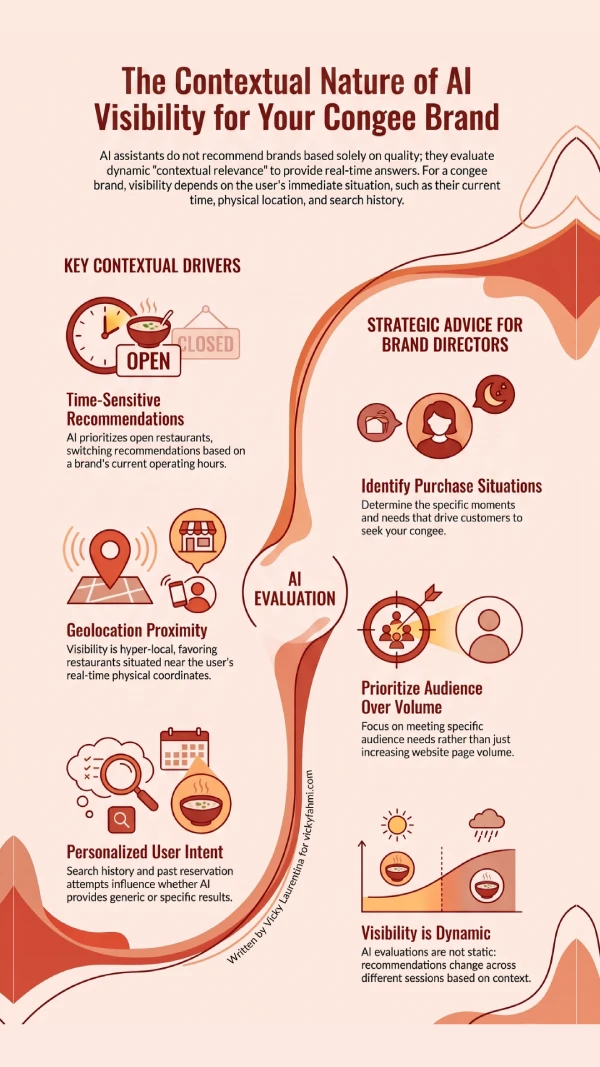
Below are examples of situations where I found AI chatbots gave different answers to similar prompts.
Time of day changes recommendations.
If I type the prompt in the morning: “Where is the best place to eat Cantonese porridge in the Ang Mo Kio area?“, the AI-chatbot will answer, “Xin Chua Congee.”
But when I type the identical prompt like this in the evening, the assistant will answer, “Xiang Chen Porridge.”
The reason was that in the morning, Xiang Chen Porridge was closed, but Xin Chua Congee was open. For the assistant, best meant the best available option at that moment, not necessarily the most delicious congee.
User history changes recommendations.
Once a friend of mine (who dislikes congee) typed: “Where is the best Cantonese porridge in Singapore?“
The chatbot answered: “Xin Chua Congee,” “Sin Weng Hua Porridge,” and “Xiao Tian Cantonese Porridge.”
But when I also typed similarly, the assistant answered: “Xiang Chen Porridge.”
This happened because I had previously used the assistant to search for a place for a family reservation, and only Xiang Chen Porridge matched that context. But my friend wasn’t interested and was simply researching, so the assistant only produced a generic answer.
Location changes recommendations.
At the time I typed “Where is a good place to eat congee in Singapore?”, the chatbot answered, “Sin Weng Hua Porridge.” But while a friend of mine typed equivalently, the assistant responded with Xin Chua Congee.
This happened because my friend was in Ang Mo Kio, where Xin Chua Congee is located. The chatbot responds according to the user’s geolocation. Since I wasn’t in Singapore, it simply gave a generic recommendation.
The AI-recommendations are highly determined by the user’s contextual relevance, and the responses continue changing based on that context.
Vicky Laurentina, 2026
If you want to strengthen your brand’s visibility, first ask what kind of audience you want to target. Once you’ve answered this question, you can then ask which contexts matter most to that audience.
This is where it’s crucial to identify the situations that make visitors want to purchase your products or services. The decision is more valuable than simply increasing the volume of pages you publish.
Recommendation Consistency Requires Deeper Diagnosis
A restaurant brand that’s repeatedly recommended by AI tools indicates that the business has strong visibility. Meanwhile, the brand that receives only occasional AI mentions suggests it’s not very visible. While it may actually serve the needs of AI tool users, the tool hasn’t yet deemed it reliable.
Instead of asking, “Is my brand appearing in AI tools?“
It’s better to ask, “In what situations do AI tools consistently recommend my business?“
Questions like this have a more operational impact and are certainly more solution-oriented.
Below are better examples of questions for you to ask:
| Less Useful Questions | More Useful Questions |
| Is my café showing up in AI recommendations? | Which dining situations make AI recommend my café instead of the place down the street? |
| Why isn’t my content bringing in more reservations? | Which customer questions, when typed into an AI tool, lead someone to book a table rather than just browse? |
| Are my competitors getting more AI mentions than me? | In which situations does AI skip my café and send a hungry customer to my competitor instead? |
Now the question is, why haven’t any AI tools deemed our brand reliable in serving its users’ needs?
Indeed, sometimes there are signs on our brand’s website pages that aren’t easily identified by AI tools. Or in other words, the content assets haven’t been sufficiently optimized for generative engines. Therefore, brand managers also need to understand generative engine optimization [GEO] strategies.
Good GEO efforts will provide you with the basic mechanisms that lead search systems to repeatedly trust your brand over your competitors in various situations. Implementing a GEO strategy strengthens your brand visibility, bringing you closer to the point where potential customers trust your restaurant enough to choose it. Find out how the GEO framework shapes your brand’s AI recommendations in this blog.
This page was originally published on September 18th, 2025, and updated on July 14th, 2026, to reflect the latest information and insights.

I am an SEO specialist with experience as a content strategist. I blog about planning and optimising content for marketing insights. See my profile page to find out more about me. Follow me on LinkedIn and Instagram.
An interesting research when combining SEO knowledge with an AI perspective.
I think restaurant owners or digital marketing team should read this review and implement it if they want to gain more benefits in today’s digital AI era.
Thanks for sharing this article, it makes me curious about the term GEO.
Thank you, Mbak Gita. I’m glad my article piqued your curiosity about GEO.
I use the term “branding visibility” to ensure that restaurant managers don’t bother making their restaurants more visible, but instead focus on making them more frequently chosen. A premium restaurant may have a delicious menu and an established reputation, but if this reputation is invisible in search engines, it’s of little use to potential customers who need to eat in certain situations.