Any chain restaurant that has marketed its numerous branches through extensive social media content may appear digitally sound, but this assumption doesn’t always mean its marketing operations are running smoothly. I once tested a restaurant with several AI tools using buying-intent prompts. It turned out that the tools repeatedly recommended restaurants that actually met the needs of people ready to buy food rather than the restaurant I was researching.
Restaurants can optimize for AI-generated search answers by compiling evidence to answer potential customers’ questions on their websites and corroborating that evidence with highly authorized 3rd parties. However, it’s still suboptimal when a restaurant is repeatedly recommended solely by ChatGPT. In my research, I found that a restaurant is truly recommended when it repeatedly appears on ChatGPT and Perplexity in several different prompts.
Evidence Changed Our Assumption
When a restaurant repeatedly appeared in ChatGPT and Perplexity simultaneously, I wondered if its success was due to its website or its extensive social media presence. My subsequent observations slowly led to the answer.
Experiment Reveals Repeated Recommendations
I began this experiment by identifying the restaurant genre I wanted to research, as well as the consumers it targets. Then, I created 4 queries that I deliberately chose to be frequently typed by customers looking to purchase the business’s offerings. These queries included:
- “Find the nearest Italian restaurant open now in Apia for dine-in“
- “Where can I get wood-fired pizza delivery in Apia?“
- “Book a table for two at a restaurant in Apia tonight“
- “Best authentic pasta carbonara near me in Apia“
Questions like these are important because customers who type them are generally ready to purchase the service the business already offers, not just curious about the other culinary delights Apia has to offer. This distinction is important because generative engines are used more by people with high intent than by those with medium or even low intent.
I summarize my experiment in the infographic below.
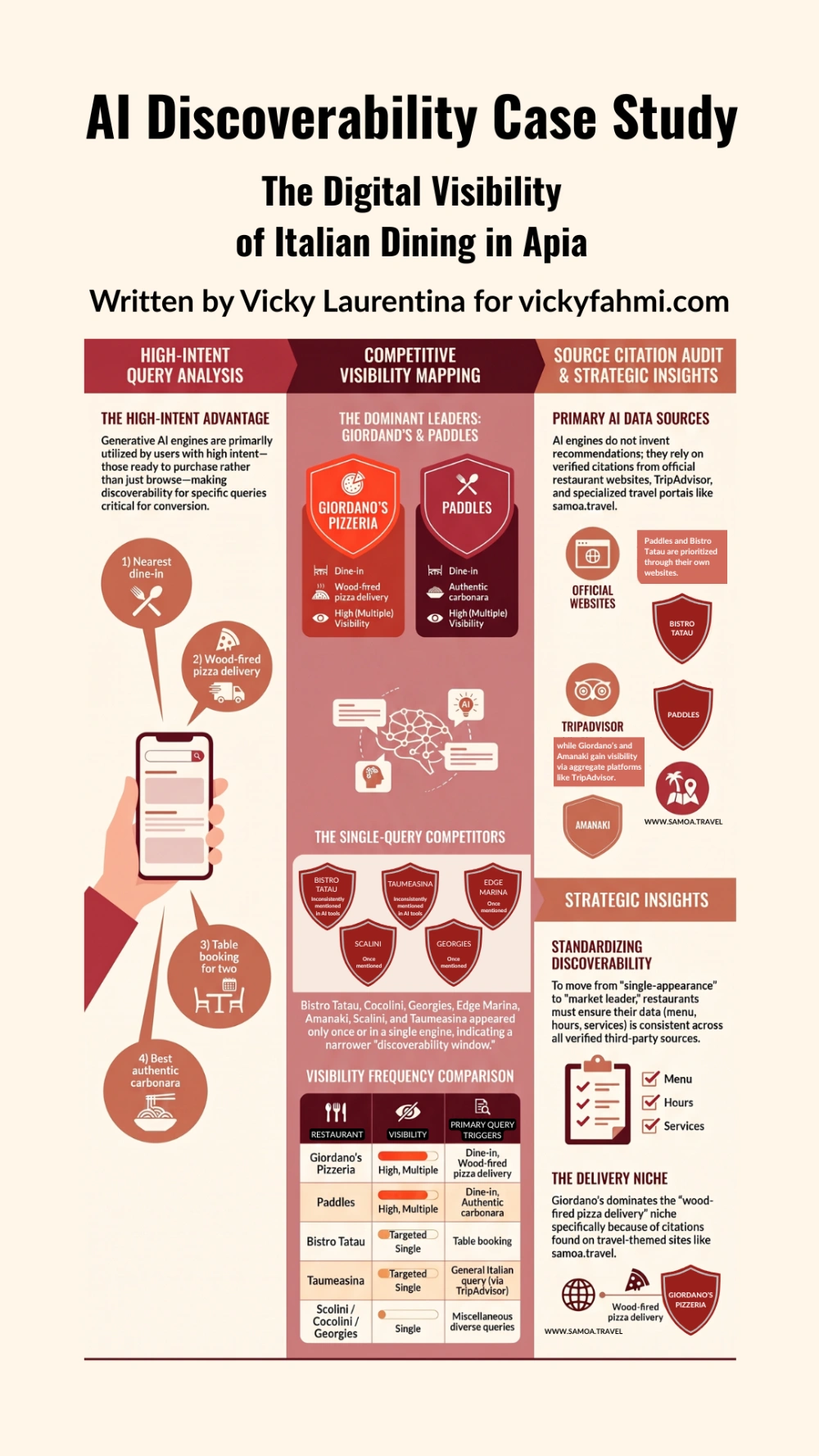
Then, when I ran these prompts in Perplexity and ChatGPT, I found the following patterns:
- 2 businesses were constantly introduced in both tools:
– Giordano’s Pizzeria, which appeared for the “Find nearby Italian restaurants open now in Apia for dine-in” and “Where can I get wood-fired pizza delivery in Apia?” prompts
– Paddles, which emerged for the “Find nearby Italian restaurants open now in Apia for dine-in” and “Best authentic pasta carbonara near me in Apia.” prompts - Some businesses appeared in only 1 prompt, or emerged in an engine without appearing in the other:
– Bistro Tatau, which appeared only for the “Book a table for two at a restaurant in Apia tonight” prompt, but not for the distinct prompts;
– Cocolini, Georgies, Edge Marina, Amanaki, Scalini, and Taumeasina, each of which appears only once for a diverse query. - Citations frequently used to support recommendations in the tools include:
– Restaurant websites, which appear in Paddles and Bistro Tatau;
– TripAdvisor, which lists businesses like Giordano’s, Taumeasina, Edge Marina, and Amanaki;
– Travel-themed websites, such as www.samoa.travel, which support Giordano’s claim to answer the question “Where can I get wood-fired pizza delivery in Apia?“
The surprising part is that Paddles also has an Instagram account, but the generative engine prefers pulling data from Paddles’ website rather than their Instagram. Giordano’s, on the other hand, does not have a website, but does have an Instagram account.
However, the tool prefers to pull data from a different website than Giordano’s, namely TripAdvisor, rather than their Instagram. This makes me wonder if consistent social media activity isn’t actually strengthening the business’s presence in the AI-generated answers.
This experiment revealed how AI tools can be selective in picking data for citations. So, why are certain websites repeatedly cited for citations, while others are rarely cited?
It turns out that this difference often occurs because the website is better able to organize its expertise on a particular topic across its entire website, rather than just on a single page. I explained this architecture in the article: Building Topical Authority via Content Architecture.
Patterns Exposed Hidden Evidence Gaps
Businesses generally strive to have their services discussed online, whether on their own websites, social accounts, or in reviews. They then hope that AI tools will incorporate these discussions into answers for their users. However, my study about Italian restaurants in Apia found that not all content sources carry equal weight when AI tools generate restaurant recommendations,
| Source Type | Citation Frequency | Example Restaurants |
| Restaurant website | Repeated | Paddles, Bistro Tatau |
| TripAdvisor | Repeated | Giordano’s, Taumeasina, Edge Marina, Amanaki |
| Travel-themed websites | Occasional | Giordano’s |
| Facebook business page | Occasional | Georgies |
| Instagram account | Occasional | Giordano’s |
Paddles and Bistro Tatau websites directly answer questions about their location, menu, delivery options, and operating hours. While TripAdvisor reinforces the identity of Giordano’s as a restaurant and claims the authenticity of Taumeasina’s restaurant genre. Facebook and Instagram accounts provide Georgies and Giordano’s locations and delivery services.
Why are restaurant websites cited more often by AI tools than social accounts? I’ve noticed that website page scripts are more renderable by generative engines than Facebook or Instagram page scripts.
In reality, not every website presents its content well to AI. The CMS behind a website influences the layout, maintenance, and rendering of pages. I explained this in the article: Choose a CMS for Scalable Restaurant Marketing
For example, Paddles Samoa clearly lists its restaurant address on its website, but its Instagram account doesn’t. This impact occurs when someone types the prompt into Perplexity: “Find the nearest Italian restaurant open now in Apia for dine-in.” The phrase “nearest in Apia” refers to the location, and only its web page explicitly answers the prompt.
Why is TripAdvisor cited more often than other websites?
It collects reviews from multiple people who have experienced the business’s service. Then ChatGPT and alternative engines use these reviews as data to answer the “Best authentic pasta carbonara near me in Apia” prompt. Websites with content written by only 1 or 2 people tend to receive lower trust weights from generative engines than TripAdvisor.
Diagnosis Guides AI Search Improvement
My findings from this experiment led me to ask how to optimize brand content to more easily address the needs of AI tool users. It turns out that optimization needs to begin by assessing whether the existing content on the brand’s page is ready to answer the questions of audiences seeking to purchase the brand’s products or services.
Website Answers Must Match Intent
To optimize a brand to meet AI users’ needs, the website’s content must be structured to answer the specific questions high-intent customers ask within the tool. The experiment showed that the Paddles page lists the restaurant’s location and availability for dine-in, making this content easily retrievable by the tool.
The business also successfully responded to the chatbot user’s question about authentic carbonara pasta, again through content within its website, this time dedicated to the menu. This content’s sentence structure enables the AI tools to recommend Paddles as a place to help users find authentic Italian carbonara pasta in Apia.
Another business, Bistro Tatau, demonstrates its easy responsiveness to the users’ needs through 3 components:
- Its homepage meta description reads, “Private/VIP dining spaces as well,” thus answering the “Book a table for two at a restaurant in Apia tonight” prompt;
- Its page’s body content reads, “Corner Beach Road and Fugalei St, Savalalo, Apia,” confirming its location in Apia;
- Its body content also states, “Opening hours: Dinner Monday to Saturday from 6:30 pm,” thus answering the dinner hour component of the prompt.
These steps are worth emulating for brands when structuring their page content to address the specific questions high-intent customers are likely to ask.
Authority Signals Reinforce Restaurant Claims
A restaurant’s efforts to claim it can meet high-intent customers’ needs on ChatGPT and Perplexity can be optimized by strengthening its authority through a highly authorized 3rd party.
Its website may claim to serve the customer’s desired menu at their preferred hours, but the 3rd party determines how credible that statement is to the AI. The experiment above shows that TripAdvisor has become a citation in both ChatGPT and Perplexity, stating Giordano’s as a restaurant that serves wood-fired pizza. The content on TripAdvisor reinforces Giordano’s claim, which was posted on its Instagram account as a wood-fired pizza provider.
Therefore, TripAdvisor is a separate website, not operated solely by the restaurant owner, but it plays a crucial role in making the restaurant a viable answer in generative engines.
TripAdvisor can make your restaurant’s reputation more credible. But its authority doesn’t guarantee that AI systems will automatically discover your operational details.
Even if your website contains accurate operational details, a lack of structured internal linking will still make those pages difficult for AI systems to find. See how internal linking can help AI engines discover operational details on your website.
Below is my advice if a business wants to strengthen its authority as a restaurant:
- Create content on its business website that can respond to prompts with transactional search intent. This content should include operational details such as the restaurant’s location, menu specifications, and whether it offers dine-in or takeout only.
- Strengthen its claim to the response by trying to get the restaurant listed on TripAdvisor and travel-related websites, making it easier for the restaurant to be included in the AI tool’s database.
- Ensure the information contained in the restaurant’s own media assets matches that of the third-party media assets. For example, if the business’s website describes its pizza as wood-fired pizza, try to have the third-party advertiser describe it similarly, not artisanal pizza, which has a broader meaning than just wood-fired pizza. Discrepancies between the restaurant’s and the third-party websites can reduce the likelihood that the generative engine will trust the restaurant as a wood-fired pizza provider.
- Continue using social media to market the business, but only as a supporting medium. Websites are still a much easier source of data for ChatGPT or Perplexity than Instagram or Facebook.
Many restaurants want their name to be featured in as many media outlets as possible. But actually, information published by 3rd parties is only used to reinforce the restaurant’s own website.
Therefore, as an SEO specialist, I tend to ensure the restaurant’s website content is valid first, before asking 3rd parties to use it as a reference.
Vicky Laurentina, 2026
Determining a website’s AI-friendliness isn’t as simple as checking the accuracy of the facts. Generally, before inviting third parties to write about a website I’m supporting, I first assess the website’s AI-friendliness using a framework for measuring whether your website is AI-ready.
Framework Prioritizes Operational Validation
Therefore, restaurants can optimize their entities to become answers in AI-generative search by validating whether their content consistently satisfies AI users with transactional search intent. This validation can actually be performed by any restaurant.
How to validate the scope of a business’s answers as a restaurant:
- Curate questions from high-intent customers.
Questions from high-intent customers are questions related to buying intent, e.g “Find the nearest Italian restaurant open now in Apia for dine-in” or “Where can I get wood-fired pizza delivery in Apia?“
Ensure that the restaurant can answer these questions. For example: If a customer requires a private room reservation, the restaurant needs to ensure that this reservation can be accommodated. - Ensure that every answer to these questions is available on the restaurant’s website.
If you serve wood-fired pizza, ensure the “We serve wood-fired pizza” sentence is literally written on the page. Images of your signboard that show a pizza figure on wood are not counted.
The existence of this website provides evidence that the business is capable of answering high-intent customers’ prompts. - Test these questions on various AI platforms.
Type the question in ChatGPT, then see if the answer mentions your place. Type the same question in Perplexity, Copilot, Gemini, and others, and also see if your place is mentioned.
If any popular chatbot does not mention your place, then your optimisation is still sub-optimal.
This testing will verify whether the platform’s answers truly support the restaurant’s business. - Align high-authority third-party references with existing operational facts.
These references are crucial for organically strengthening the restaurant’s claims. A third party can be recognised as high-authority if it is popular as a customer reference in your industry, such as TripAdvisor, Yelp, and similar sites. These references are crucial for organically strengthening the restaurant’s claims.
Instagrammers or TikTokers can’t be considered high authority because, so far, AI tools haven’t trusted their recommendations. These references are crucial for organically strengthening the restaurant’s claims.
Every restaurant may have taken these steps. One restaurant consistently appears in AI recommendations, while the others remain unrecommended. This could be because not all marketing teams can measure the quality of their published content, or even the authority of third-party content published about their restaurants.
Can you ensure your restaurant has made every effort to recommend your business to customers ready to dine at your place? Consulting with an SEO specialist knowledgeable in generative engine optimization will help you diagnose gaps in your business and help you become a leader in AI recommendations.
I evaluate brand content through structured analysis, as well as checking the quality of other sources supporting the brand and analyzing audience search behavior using AI platforms. I conduct all of these evaluations before recommending any optimization work. Learn more about my work on my profile page.
This article was first published on October 9th of, 2025, but it was updated on July 1st of 2026, to give the audience the latest insight.

I am an SEO specialist with experience as a content strategist. I blog about planning and optimising content for marketing insights. See my profile page to find out more about me. Follow me on LinkedIn and Instagram.
Learning AI search optimization is really challenging, right? Then when we seek for a thing on Google, the first result is answered by Gemini AI.
I really curious about topical authority.
Jadi tidak usah lagi mencari long tail keyword, repetisi keyword, seperti dulu, Kak Vicky? Kalau ingin fokus ke AI search optimization.
Repetisi keyword sudah tidak diperlukan lagi untuk mengoptimisasi supaya bisa masuk ke AI search. Tapi long tail keyword masih dibutuhkan, karena umumnya orang mengetik di Gemini itu menggunakan long tail keyword tersebut.
wah sekarang nggak cuma googe, ya tapi artikel kita juga harus dikenali sama AI biar bisa masuk rekomendasi juga. Kayaknya AI ini perkembangannya cepat banget ya, mbak yang dulunya mungkin cuma buat bikin artikel sekarang juga jadi penentu dalam ditemukannya website oleh mesin pencari
Betul. Dan yang sering luput kita sadari, AI itu bukan membaca artikel doang, tapi dia juga menilai apakah sebuah website itu cukup meyakinkan untuk disebutkan ke orang lain. Jadi, cerita di website kita harus cukup jelas dan konsisten sampai AI berani bilang, “Oke, artikel ini layak direkomendasikan.”