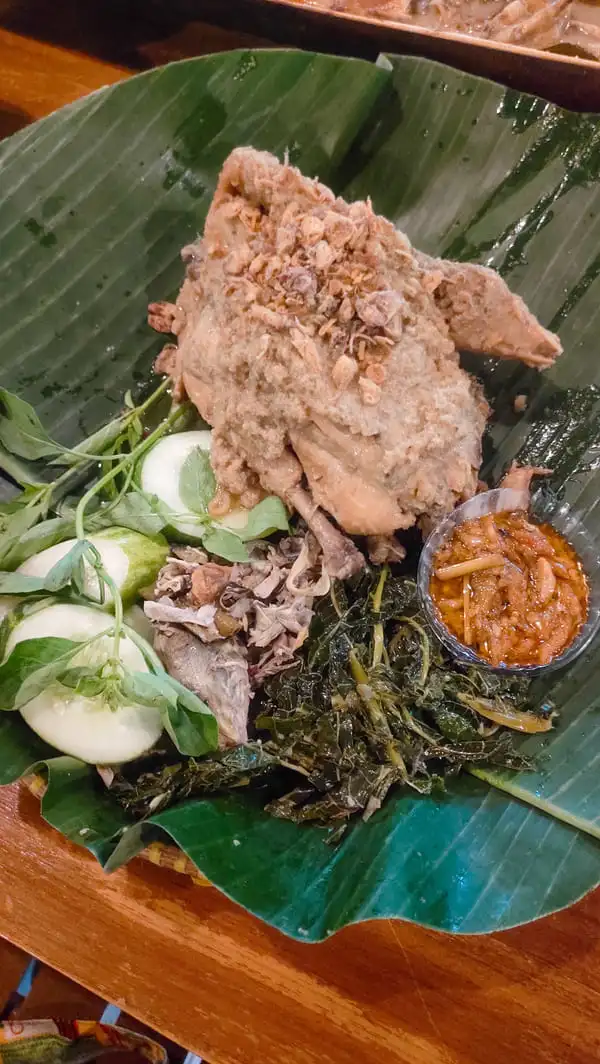
Some websites collapse under their own traffic because the keyword strategy they used no longer works today. For example, a Javanese restaurant website used to optimise for generic terms like ‘traditional food’, but today the market is more in search of health-driven keywords. Forcing the website to keep attracting tourists hunting for Instagram moments, while actual buyers want to order a fibre-rich meal, is useless.
Optimising for search engines today is no longer supposed to boost website session numbers. SEO should be expected to generate revenue. This is why it should start with choosing keywords that match decision-stage searches, not just curiosity clicks.
Click here to find out if you don’t know what a keyword is.
A keyword is the specific phrase someone types when looking for a solution. It signals whether someone is browsing or buying.
Keywords People Still Search for
You’re probably aware that your restaurant ranked first for “best traditional food” because the volume looked impressive and Google Search Console showed its impression spiked for three months. But don’t be surprised if orders barely moved.
This is because the keyword attracted casual browsers. People searching for cultural context found your site, but they weren’t searching for a table reservation. It’s common when teams prioritise search volume over audience understanding.
Next is what I usually do when choosing keywords.
How to choose keywords for SEO?
- Start by clarifying who’s searching.
I map the target audiences, including their age, where they live, what decision they’re trying to make, and what outcome the business actually needs from that visit.
- Trace how language shifts as intent matures.
Trace from exploratory questions, to comparison phrases, and to price- and availability-driven searches. Anchor each page to the stage where the brand is meant to win, until alignment is precise.
- Validate whether the phrase is viable in search and sustainable for the brand to own.
So, every selected keyword serves a defined role in the customer journey, rather than competing for attention or inflating meaningless traffic.
To trace how language shifts intent maturity, I map each keyword to the customer journey. In this journey, we group users into stage of Awareness, Consideration, and Decision.
Awareness is a stage when they realise they have a problem. Consideration is when they’ve identified their solution options but don’t know which to choose. Decision is when they’re ready to select the option but want to learn how to pay the price.
For example, health-conscious diners don’t just type “traditional food”. They search “what are fibre-rich Indonesian meals” or “examples of healthy Javanese chicken dishes”. This keyword is the Awareness Stage. Find the relevant keywords in the following stages at the table below.
| Journey Stage | Keyword | Intent |
| Awareness | “what are fibre-rich Indonesian meals”, “examples of healthy Javanese chicken dishes” | Exploratory, educational |
| Consideration | “fibre-rich Indonesian meals near me” | Comparison, location-based |
| Decision | “how much is ayam nglumut at XXX Restaurant” | Price, availability |
Do you notice that the examples I show above are long-tail keywords? Long-tail ones usually have lower search volume. But their specificity is higher, so they convert better because they capture decision-stage intent rather than passive curiosity.
If your restaurant positions ayam nglumut as a wellness dish, the winning keyword isn’t “Javanese restaurant.” It should be “healthy Javanese chicken with traditional herbs.” Don’t be nervous if you only get fewer visitors, because those visitors usually have stronger buying intent and higher trust in your brand.
(Far before AI reshaped search, these longer phrases already delivered more qualified traffic than short generic terms, even with smaller search volume.)
Choosing the Right Focus Keyword
I’ve found that many businesses scatter their homepage across two or three competing terms at once. None anchored the narrative. Search engines couldn’t determine what the page was about, and neither could readers.
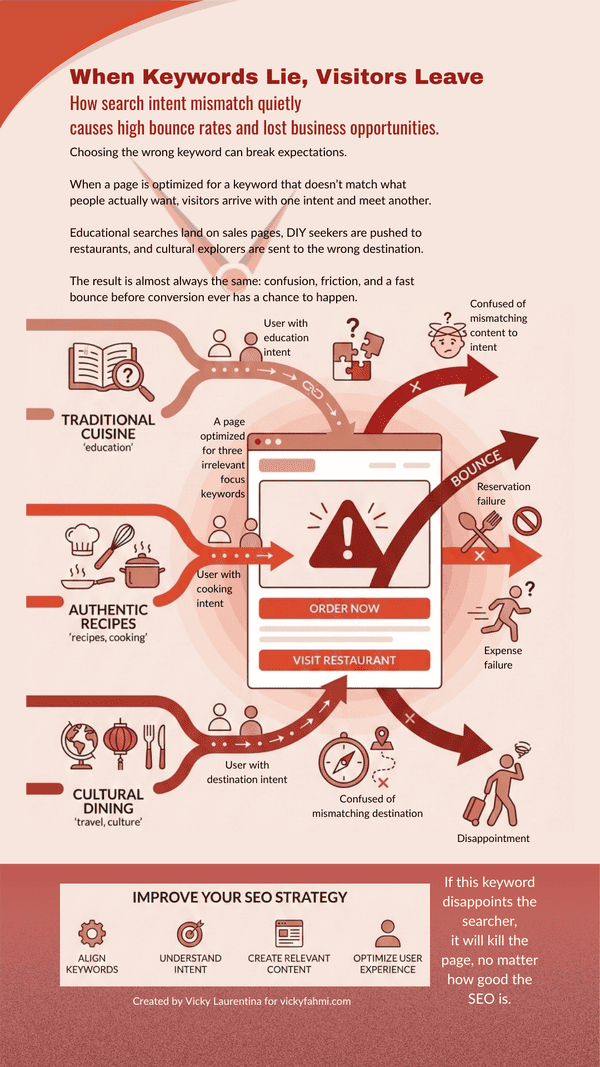
In most cases, failure in choosing a suitable keyword is caused by a strategic misclassification of intent. The right time to optimise pages for evaluation is only when the query already signals readiness to act. I unpack the distinction and how to correct it without compromising brand integrity or focus in the article about transactional search intent that drives revenue.
Your primary phrase should reflect what the brand wants to be known for, not just what generates the highest volume. It must align with positioning, audience language at their decision stage, and the business outcome you’re targeting. The business outcome can be reservations, orders, or sustained visibility.
So, selecting your primary phrase means identifying one central idea you want to be trusted for. The focus keyword should align with your brand promise and the outcome you’re driving.
For a restaurant framing ayam nglumut as a health-forward choice, that phrase might be “healthy traditional Javanese chicken.” Every heading, menu description, and paragraph should orbit this anchor, without forcing awkward repetition or robotic phrasing.
SEO doesn’t ruin brand aesthetics when it’s executed intentionally. Your primary term should feel native to your story, not bolted onto it. The goal is clarity for search engines and emotional resonance for readers who evaluate your content based on how it makes them feel.
If you’re bending the narrative to accommodate a phrase, then you’ve chosen the wrong one.
A Keyword Strategy That Lasts
Plenty of websites have published optimised content years ago and never adjusted it. Over the years, the owners have wondered why their traffic has decreased and why new competitors have emerged, attracting more visitors to their parking lot.
Search behaviour has shifted today. Health-conscious diners are now asking about “gut-friendly fermentation” and “anti-inflammatory spices”. You can’t fulfil their needs if your content still emphasises “authentic tradition,” even though your chicken dish is still as delicious as it used to be. The strategy died because it never adapted to how language evolved.
A good one is a sustainable approach that adapts to shifts in audience behaviour and search trends. Most critically, it connects search terms to business outcomes like revenue and trust.
So, building sustainable content means treating content as a living system, not a one-time project. What I work on is not just monitoring traffic; I also monitor what audiences are currently searching for and update existing pages based on behaviour shifts.
When you adjust selected keywords to match what people actually search for today, visibility metrics for those specific phrases improve. Better visibility positions the brand in front of ready buyers at the exact moment they’re searching, which directly increases the likelihood of reservations and orders. This is where keyword adjustment translates into measurable revenue growth.
Click here to find out what you can execute to improve your keyword selection next week.
1. Open your most-visited page and identify the current primary keyword it targets.
2. Check if that phrase still matches what your ideal customer would type today, not three years ago.
3. If it doesn’t, rewrite the page title, first paragraph, and three headings to anchor around the updated phrase.
4. Monitor position changes for that specific keyword over the next 90 days. This single adjustment often reveals whether your visibility problem is strategic or technical.
I also prioritise quality over quantity. It’s better to publish two deeply researched, strategically positioned pieces each month than ten shallow ones that rank briefly before fading into irrelevance.
What separates lasting approaches from temporary wins is tying search terms to business outcomes, such as reservations, repeat orders, and trust-building. The strategy protects revenue by staying relevant as audience needs change.
(But most DIY efforts stop working here: they treat optimisation as a checklist item, not an ongoing adjustment.)
For brands built on feeling and consistency, the wrong keyword doesn’t just miss traffic, it erodes perception.
Vicky Laurentina, 2025
Does your restaurant’s search strategy feel like guesswork? Or is your traffic not converting into orders? Get someone who understands both optimisation systems and brand voice.
I’ve spent years turning complex search behaviour into clear business leverage for brands that refuse to compromise on aesthetics, trust, or revenue impact. If your brand lives on narrative, consistency, and feeling, come to my profile to see how I align search strategy with brand storytelling, without flattening the aesthetic.
(I don’t publish keyword-stuffed pages or flatten brand voice for rankings.)
This article was published in June 17th of 2022, then got updated in February 8th of 2026 to give you latest insights.

I am a content strategist who loves blogging about planning and optimising content for marketing insights. See my profile page to find out more about me. Follow me on LinkedIn and Instagram.
Makdess…aku kaya ketimpuk.
hehehe.. Bolehkah kalau aku berpikir begini kak Vick.. “Karena blog kak Vick sudah memiliki memiliki ‘nama’ atau exposure di mata google, sehingga tema yang ditulis harus relate antara satu dengan yang lainnya, meski judulnya lifestyle blogger?”
Atau mending posting setiap hari dengan tema-tema random dan ini berarti riset keywordnya juga itu-itu aja..
huhu…masih mencari celah dengan yang namanya keyword ini, kak Vick.. karena gak langganan ahrefs dan hanya mengamati jetpack dengan pencarian terbanyak dari blog lendyagassi.
Terimakasih kak Vicky.
Aku juga nggak langganan Ahrefs. :)) Memangnya harus ya langganan Ahrefs itu? :))
Sebentar, coba kuulang pertanyaan Lendy dulu: “(Apakah) tema yang ditulis HARUS relate antara satu dengan yang lainnya?”
Tentu saja enggak. Beberapa hari yang lalu aku nulis soal Sophia Latjuba mantu. Itu jelas nggak ada hubungannya dengan tulisan-tulisanku sebelumnya.
Aku nulis soal Sophi mantu karena.. yaa ada isu yang kutarik dari acara mantunya Sophi ini, dan aku sangat kepingin mengabadikannya untuk kesenanganku pribadi.
Karena tujuan akhir blognya vickyfahmi.com ini memang “memuat tulisan-tulisan kesenanganku pribadi”.
Kalo memang kesenengan pribadinya random, yaaa silakan aja. (Sebab yang punya blog memang orangnya agak random..)
Dan oleh karena kesenengannya random, akibatnya, riset keyword-nya juga random lah. Logikanya gitu kan?
Riset keyword itu tidak selalu untuk bikin posting baru lho. Riset keyword itu juga berlaku untuk perbaiki meta description setiap posting lamanya.
Blogger yang biasanya suka perbaiki metadescription dari posting lama ini, adalah blogger yang punya plugin SEO 🙂
Kalau bloggernya tidak punya plugin SEO, dia jarang perbaikin metadescription pada postings lamanya.
Aku lagi berpikir. Ini artikel-artikel lamaku yang nggak pernah dapat perhatian pembaca kudu diapain ya biar dia bisa cemerlang dan jadi perhatian lagi.. Then aku mulai paham triknya setelah ini. Thank you, Mbak Vicky.
Ya, sama-sama..