There’s no standard SEO formula for restaurants. When comparing SEO providers, the biggest difference is whether they prioritize optimizing your Google Business Profile (GBP) so local customers can find your eatery, or optimizing your website to highlight your place’s unique services.
This distinction doesn’t automatically mean a specialist provides the right or wrong solution. The more important question is, can the provider’s methodology address your restaurant’s visibility issues? Therefore, your partnership choice should be based on your specific problems, not on the practitioner’s list of proposed actions.
How Do GBP and Website Optimization Differ?
The disparity between the two SEO methodologies depends on your restaurant’s visibility problem in search results. When choosing a method, first consider where you still feel most invisible.
GBP-Led Work Focuses on Local Discovery
Situations where your restaurant needs to focus on GBP optimization
- Purpose: Make your brand more discoverable to people in the surrounding area who are seeking a dining place.
- Deliverable focus: GBP account and its appearance in local search results.
- Business problem: Many competitors in the same geographic area target the same customer: people who want to dine nearby.
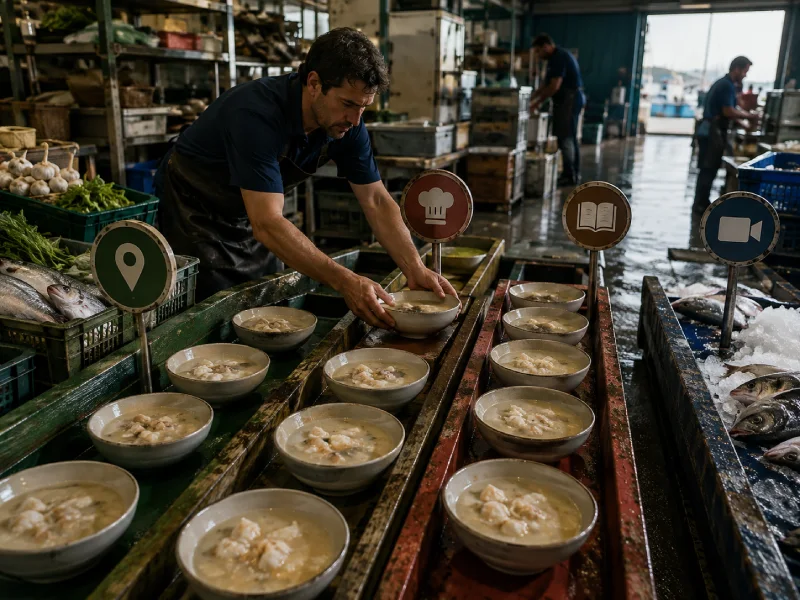
For example, someone is in your restaurant’s zone and looking for a place to eat gazpachuelo. Your business serves it, but they don’t know your brand’s name. This methodology will work if the name is recommended when the public asks where to enjoy this Spanish dish not far from their location.
Once local competition is the reason for poor visibility, the next question is whether this methodology can actually improve discovery. One way to assess this is to look at what happened to restaurants after specialists improved their GBP. Many restaurants have proven that after improving their GBP, their visitors actually increased.
You need to note that GBP improvement is not the only action that they do.
Vicky Laurentina, 2026
They do other things unrelated to GBP as well, especially website improvements. I’ll give you an example of an agency case study to explain this.
An agency optimized a brand in Surrey, Canada, with an out-of-date GBP. The agency’s deliverables included GBP optimization, faster website loading, and a dedicated landing page for its restaurant services. After all these activities for 6 months, the brand’s diners increased by 40% compared to the pre-optimization period.
Website Optimization Focuses on Broader Discoverability
Situations where your restaurant needs to focus on website optimization
- Purpose: Improve the brand’s readability and discoverability using the website content.
- Deliverable focus: Information on the restaurant’s website regarding its menu, services, expertise, and specialty compared to other eateries.
- Business problem: The restaurant is indistinguishable for its specialty (or is not even recognized for its menu).
Website optimization is necessary when neither search engines nor answer engines can understand what makes the eatery unique, and that uniqueness cannot be conveyed by GBP alone. A website offers greater flexibility because it can provide comprehensive information about the restaurant’s unique characteristics when structured in a certain way. These pages are labeled to inform the systems why this brand is extra relevant to certain customers.
Imagine an eatery offers a service where customers can enjoy a meal while watching live cooking. In my work as an SEO specialist, I would create a dedicated page for live cooking. I would place specific labels on certain sections of the page, containing relevant words for people seeking a place to cook live in front of guests.
For example:
- There’s a title like “Live Cooking at Eatery X.”
- The content’s subheading describes the dishes cooked in front of guests.
- Another subheading describes the opportunity for guests to participate in cooking with the chef.
Optimizing a website allows restaurants to convey their expertise more comprehensively to the system, rather than serving only as a company profile. The system will then convey this expertise to the relevant audience, exposing the restaurant to those who genuinely crave its food or desire its experience.
But having this information on your website does not automatically mean AI engines will recommend your restaurant. You also need to test whether your website actually provides the evidence AI engines use when answering high-intent customer questions. See how restaurant website content can influence AI-generated search recommendations.
| Google Business Profile Work | Website Work | |
| What It Does | Gets your restaurant in front of people nearby who are hungry right now and searching for a place to eat. | Helps search systems understand what makes your restaurant special, so they recommend you to the right customers. |
| Where the Work Happens | Your GBP listing [hours, menu, photos, reviews]. | Your website pages [menu pages, specialty pages, service description]. |
| Best For | Your restaurant is good, but people in your area don’t know you exist yet. There’s competition nearby, and customers are searching for “restaurant near me” or “where to eat [your area]”. | Your restaurant has something special [a unique dish, a private dining room, a specific expertise], but nobody knows about it. People can’t find you when they search for that specialty. |
| What Gets Better | More foot traffic from local searches. More people clicking Get-Directions to your location. More reservations from nearby customers. | More people finding you when they search for your specialty. More website visitors coming from people who specifically want what you offer. Better visibility in AI search results. |
Which Methodology is Relevant for a Restaurant Brand?
No SEO methodology becomes a standard for all restaurants. To determine the most relevant methods for your restaurant, prioritize the aspects of your business that remain invisible; this prioritization will determine the appropriate methods.
Prioritize GBP Optimization when Local Discovery is the Main Problem
If you want your restaurant to reach an audience looking for nearby food, prioritize GBP optimization. These people search for information that meets their needs; the search system then reads their geolocation tags and finds restaurants that match them.
How to implement GBP optimization:
- Research the audience needs.
Estimate what types of queries they might type when they want to eat. Potential target queries include “gazpachuelo open now near me“; “where can I have gazpachuelo in Malaga“; and “want to make a reservation for a Spanish meal for two.”
- Update the fields in the GBP account.
The research results determine how the fields in the GBP will be tailored to their needs. If my target audience wants to enjoy gazpachuelo, I’ll ensure that the Menu field in the GBP contains the word “gazpachuelo.” Then, if I want hungry people at 9:00 AM as my customers, I’ll ensure that the GBP account’s Opening Hours also include 9:00 AM.
- Include relevant photos.
Make sure the uploaded photos align with the needs of your target audience. If the business wants someone who slurps soup in the morning, I’ll include the restaurant’s soup dish, with a background that reflects the place’s morning atmosphere. If the target customer needs to make a reservation, I’ll include a photo of the signage that says “Reservation.”
- Utilize the Reply field.
Respond to customer reviews by mentioning keywords that the target audience is likely searching for. Suppose a visitor leaves a review for your place. At the same time, you want to promote your gazpachuelo menu, which uniquely doesn’t feature fish.
So, write a reply like this: “Dear X, thank you for dropping by our eatery. Please return sometime and try our other menu items, like our patatas gazpachuelo, which is perfect if you’re craving a fish-free gazpachuelo.” - Measure visibility for your target keywords.
Review the results in your analytics tool to see if you’re capturing queries that meet your target audience’s needs.
- Measure targeted customer visits.
Your target customers need to be significantly more than during the pre-GBP optimization period.
I’ve observed that these steps are actually actionable if your specialty is strong. But even well-executed GBP optimization has a limitation when more than 3 restaurants compete for the same local audience. You’ll need additional factors to differentiate your eatery from the competition, and sometimes your website will help communicate that differentiation to your target audience.
Broader Discoverability Calls for Website Optimization
A website should be prioritized as an SEO strategy when a restaurant wants to highlight its specialty, and that specialty struggles to be understood by search systems solely through its GBP profile.
An example that requires this method is when a brand offers gazpachuelo, and its outlet is located in a Malaga neighbourhood that is full of seafood eateries. This outlet has a view to the sea. But when discussion forums discuss which dining place in Malaga has a sea view and serves gazpachuelo, this brand doesn’t appear among the recommendations.
Declaring itself with a photo showing the interior with sea-view windows isn’t enough, because search and answer engines require more evidence. This evidence can take the form of content that demonstrates that authenticity, such as an article that shows how happy customers come to eat gazpachuelo by looking at the sea, or describes how people can sit near the sea-view windows without an RSVP. Relying on GBP can’t be relied upon to surface these kinds of details, so these topics are more accessible on a website, as long as the website has been optimized for answer and search engines.
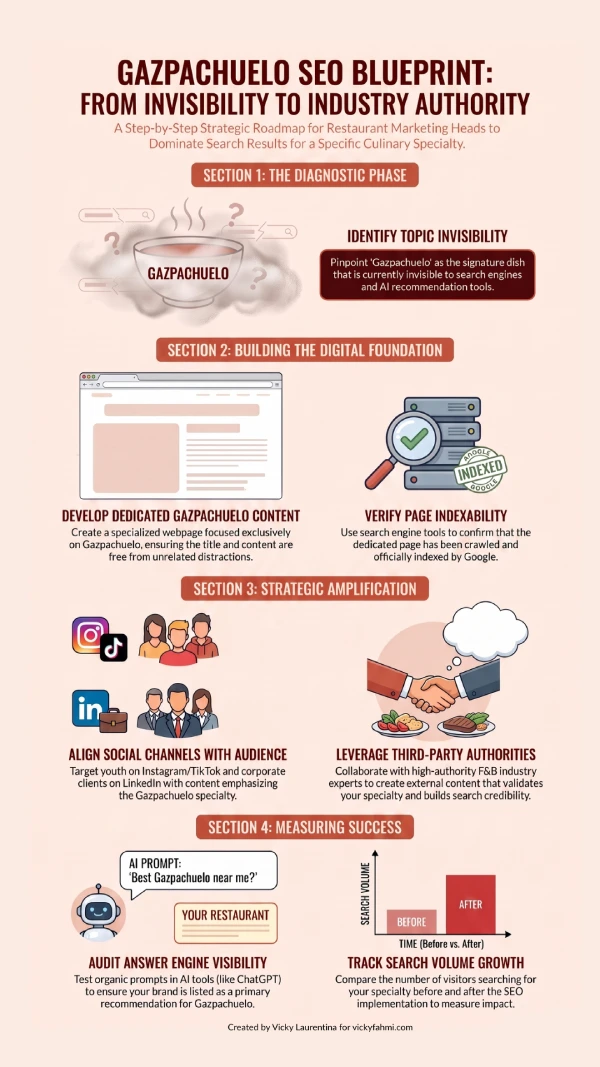
How to implement SEO for a restaurant using a website:
- Identify the brand’s topic invisibility. Which topics do you want to highlight that are currently invisible in Google and Copilot? The answer could be: the business hasn’t been recommended as a place to serve a particular menu, or the business isn’t recognized for having private rooms for groups, and so on.
- Dedicate a page to highlight these invisible topics. This page should consistently describe a topic from start to finish. For example, if the brand expects to be recognized for serving gazpachuelo, the dedicated page should have a title that focuses on the brand’s gazpachuelo. And its content should be free from discussions that are not focused on gazpachuelo.
- Ensure the page’s crawlability and indexability. Once the page featuring the topic is published, ensure that Google has indexed it.
- Optimize social media according to your target audience. Young audiences generally use Instagram and TikTok to find places to eat, while corporate audiences use LinkedIn to find gathering venues. A brand’s official social media accounts should feature content that also emphasizes its invisible topic, enabling Google and ChatGPT to obtain more reliable information.
- Collaborate with 3rd parties. These 3rd parties are external to the brand and should hold high authority in the F&B industry. Ask them to create content that discusses your business’s invisible topic, as a way to inform search systems about your business’s specialty.
- Measure its brand visibility for that topic. Test it on answer engines by typing organic prompts related to the topic. Ensure the brand’s name appears as a recommendation.
- Measure the number of visitors searching for that specialty related to this topic. Compare this number to the number before the page was published.
So, the difference between GBP-led optimization and website-led optimization methodologies lies in the business’s invisibility. A business struggling to compete for discovery among locals will certainly require a different approach than an eatery that wants to be known for its specialty. The choice of method will determine which assets are prioritized to improve this visibility issue.
Of course, the way to measure the success of each method differs, so the key performance indicators (KPIs) used to assess their success also vary. What KPIs are used for this SEO? Learn which SEO KPIs reveal whether your provider’s chosen methodology is working in the article below.
This blog post was published on January 23rd, 2026, and updated on August 17th, 2026, to give you the latest insights.

I am an SEO specialist with experience as a content strategist. I blog about planning and optimising content for marketing insights. See my profile page to find out more about me. Follow me on LinkedIn and Instagram.
kalau untuk website restoran begini berarti memang harus punya tim ya, mbak untuk mengelola websitenya. aku kemarin ketemu website untuk restoran ramen di kotaku tapi sayangnya artikelnya nggak update cuma sedikit aja isi websitenya
Sebenarnya untuk mengelola website itu tidak harus memiliki tim sih. Yang penting, ada seseorang yang bertanggung jawab memastikan bahwa konten-konten di website-nya itu:
– masih relevan dengan pangsa pasar restorannya
– saling terhubung dengan rapi
Website yang konten-kontennya begini akan membuat restoran di balik website-nya lebih konsisten terlihat di search engine.